
National Defense is always changing, but one of the most revolutionary innovations in the last few years has been the advent and rapid advancement of unmanned aerial systems (UAS), commonly referred to as drones. These inexpensive and deceptively simple aircraft have altered warfare and rapidly changed much of the thinking behind national security.
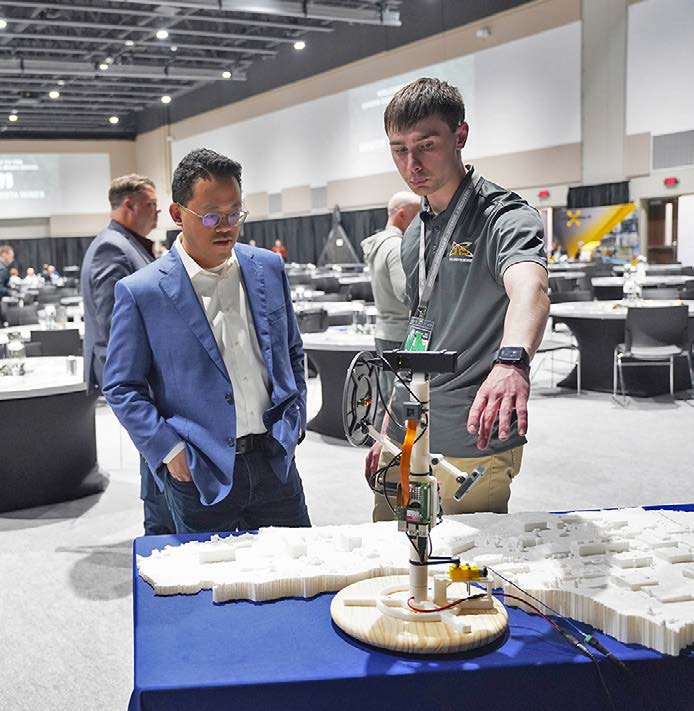
South Dakota Mines students Zack Holloway and Isaac Adsit, both Computer Engineering majors, are part of a group of young engineers whose work and understanding of UAS is now being sought out by the military.
From Campus Club to Military Consultants
The relationship between the SD Mines UAS Club and the military, much like UAS technology itself, has advanced exponentially. The Club identified a desire by the Department of War to further enhance abilities to counter drone activities near military installations and operations. This resulted in a partnership with Ellsworth AFB, SDANG, and local law enforcement on a project to strengthen awareness and security in this rapidly evolving area. Using SD Mines campus as a simulated military environment (called Camp Rocker), the students demonstrated how small drones — some costing less than $1,000 — can operate at high speeds and low altitudes while avoiding traditional radar.
This simulation helped shift the military’s perspective on what a drone threat could actually look like stateside. “We explained that this doesn’t necessarily look like what we’re seeing in Ukraine, where the assumption is ‘drones go boom,’” Zack said. “We explained how drones can see into your facility’s thermal layer, the electromagnetic spectrum, stuff like that, which is a lot more important stateside.”
Zack, Isaac and other members of the UAS Club were invited to present these findings at the annual Black Hills Defense & Industry Symposium. The team has also established an ongoing collaboration with Air Force agencies and SDANG to work together on enhancing real-world readiness.
Bridging the Readiness Gap
Zack doesn’t mince words about the current gaps in domestic preparedness. He highlighted a glaring vulnerability in how modern forces are preparing for this new era of warfare and security. “Normally, the U.S. is always the leader in this stuff. And right now, I would argue the U.S. is very much behind in this tech,” he warned.
This urgency is a motivator for the SD Mines team. For Isaac, the endless hours of engineering, researching and building boil down to something deeply human. “Hopefully our country never goes to war in a conflict with a near-peer (like Russia or China) with this kind of technology, but being able to say that maybe I helped even one soldier come home to their family makes me feel really good.”
Isaac, Zack and the rest of the SD Mines UAS Team have become part of something larger: a vital feedback loop where emerging engineers and active defense professionals are learning from each other just as quickly as the technology itself is evolving.
By Stephen Simpson
Photo courtesy of SD Mines