
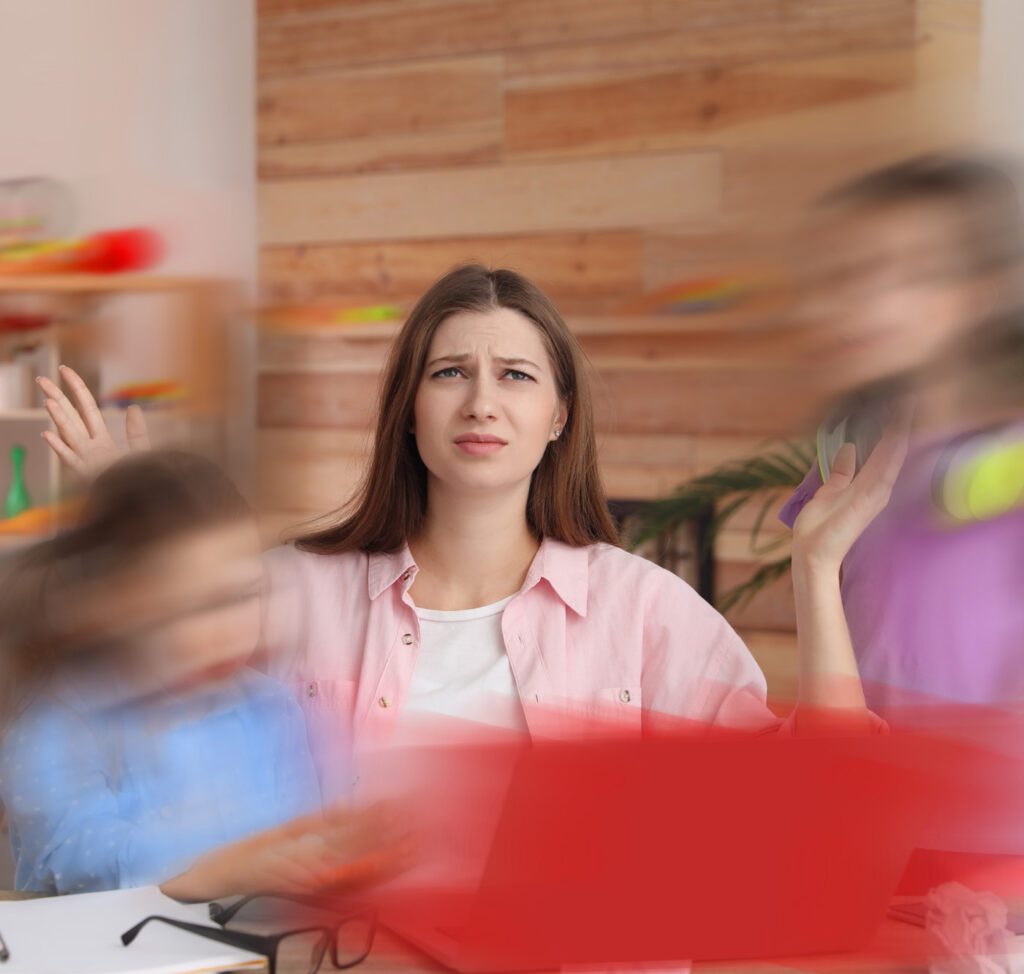
As parents, we’ve all been there: The toys are beeping. The tablets are blaring. The TV is blasting. And the kids — whom we love more than life itself — are blabbering.
Overstimulation is what happens when our nervous system takes in more sensory information than it can handle. That overload causes our body to shift into fight or flight mode. This prickly state is called dysregulation. During the back to school season — full of new beginnings and jam-packed schedules — it’s vital to understand that overstimulation and dysregulation isn’t a moral failing. Rather, this phenomenon is just our nervous system doing what it’s designed to do.
How it works
Most parents don’t realize they are overstimulated until they snap, withdraw or otherwise react in a way that feels out of character. But the outburst doesn’t just materialize out of nowhere. Hannah Simms, who is a licensed clinical therapist and founder of Rise Alone Therapy, compared being overstimulated to a pressure cooker with no way of letting its steam out. If the heat keeps rising and the pressure has nowhere to go, eventually, the lid is going to blow off.
A common misunderstanding is that blowing up or snapping is tied to a specific major event or trigger. The nervous system, Hannah explained, does not necessarily operate logically like that. “You can actually be dysregulated and really be having a good day,” she said. For overloaded parents and kids — especially during back to school season — this overstimulation can come from a variety of places: noise, heat, decision fatigue, change of schedules, parenting demands, work pressure, even lack of sleep.
“Usually when you’re overstimulated, you’ve been dysregulated for a period of time,” Hannah went on. In other words, the gradual accumulation is what causes us to hit that point of snapping.
How to stop it
The key to preventing and breaking this cycle of overstimulation and snapping, according to Hannah, is not perfection or more willpower. The key, she said, is early intervention.
Learn to look for the signs. For some people, it’s jaw tension or teeth grinding. For others, it’s irritability that feels unexplained or even a sensation of restlessness, like the body cannot settle. It might be tightness in the neck and shoulders. Sometimes it is as simple as noticing that everything feels slightly louder or more annoying than it should.
These signals are easy to overlook, but these symptoms and others are often the earliest indicators that the nervous system is approaching its limit.
One of the most practical ideas in prevention is also one of the simplest. When you notice early signs of overstimulation, a brief interruption can change your trajectory. This can look like stepping away for a moment, going to the bathroom, going outside or putting on your earbuds and listening to calming music. These micro-pauses can relieve a little bit of the accumulated pressure on the nervous system and create a chance to prevent further escalation.
This doesn’t need to be a long break or be particularly elegant. It only requires enough distance from stimulation to interrupt the accumulation. Hannah noted that this is not always easy, especially for parents whose lives do not naturally allow for pauses. But even the tiniest of interruptions can matter more than people expect. So, take out the trash, water the garden, even just go for a drive. “There’s power in that pause,” Hannah said.
Grace
Many people — especially parents — impose an extra burden on top of overstimulation by piling on guilt and shame after snapping at a loved one.
Hannah pushed back on that reaction. “Give yourself a lot of grace. You are a human being after all. Perfection is not the expectation.”
Human nervous systems are not designed to remain regulated at all times. Fluctuation is normal. Overload is not a moral failure. “I’m not perfectly calm 24/7, and I’m a therapist!” Hannah laughed. This point is paramount, since shame often intensifies the recovery process. Instead of simply returning to baseline, parents can carry an additional emotional weight: frustration and guilt.
Removing that layer of judgment does not eliminate stress, but it reduces the secondary spiral that often follows it. And for families in the Black Hills, especially during this back to school season, that grace can be huge. Outbursts are going to happen — both from parents and kids. Be quick to forgive when that happens. Then, let’s do our best to create space and peace at home — for ourselves and our spouses and kids. And, as Hannah reminded us, it’s heroic to ask for help: “If you’re staying at a point of dysregulation for a long period of time,” she said, “talking to a professional is helpful, too. No shame in that.”
By Stephen Simpson